A market umbrella is a patio umbrella with a center pole that runs straight through the middle of the canopy, supporting it from below. The pole sits either in a table umbrella hole or in a freestanding weighted base. This center pole design separates market umbrellas from offset umbrellas and cantilever styles that use side poles.
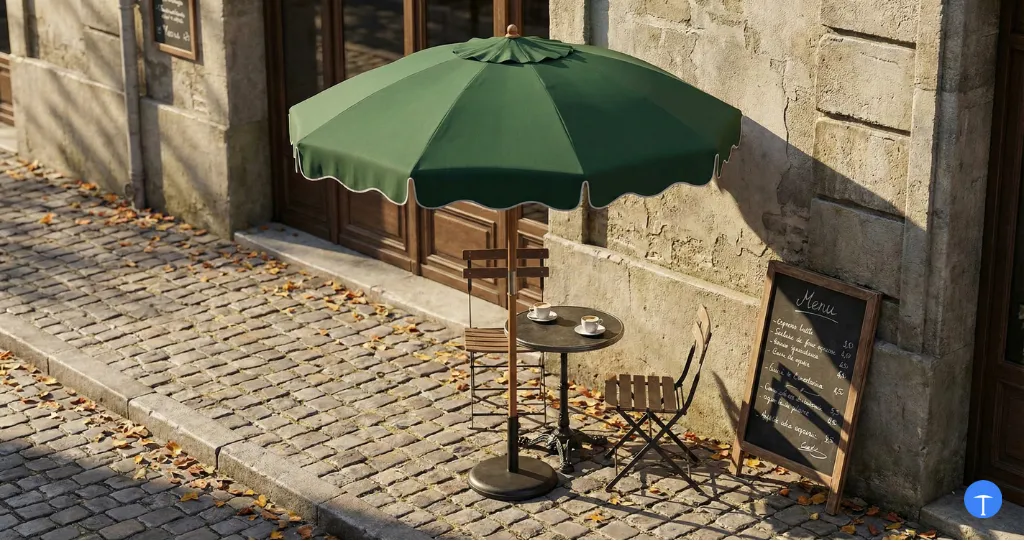
You will hear “market umbrella” and “patio umbrella” used interchangeably, but market umbrella specifically means the center pole style. For more on how these terms overlap, see our guide on market umbrella vs patio umbrella.
What Makes a Market Umbrella Different
The name comes from European outdoor markets and café culture, where center pole umbrellas lined market stalls and sidewalk cafés. Vendors needed something portable yet sturdy enough to shade customers all day. That design made its way into the American patio furniture industry, and the name stuck.
What defines a market umbrella is the single vertical pole rising from the center. Picture a pole anchored at ground level through a table hole or heavy base, going straight up through the middle of the canopy. At the top, ribs radiate outward from a central hub, and the fabric canopy stretches across those ribs.
This center pole design keeps the umbrella lightweight compared to offset styles. You can tilt it, crank it open, and move it around without needing two people or a 200 pound base.
How a Market Umbrella Works
Market umbrellas use straightforward mechanics to open, close, and adjust for sun angle.
Opening Systems
Three main opening systems exist. Push up mechanisms are the most basic and budget friendly, requiring you to manually slide the runner up the pole and lock it with a pin.
Crank lift is the most popular system. A handle near the base turns a gear that raises or lowers the canopy smoothly. Most crank systems last for years with minimal maintenance.
Pulley systems use a rope and cleat setup, common on wooden market umbrellas. You pull the rope to raise the canopy and secure it on a cleat.
Tilt Systems
Tilt lets you angle the canopy to block sun as it moves across the sky. Fixed or no tilt umbrellas stay straight up.
Manual push button tilt is common on mid range models. You press a button on the pole, adjust the angle, and release to lock.
Auto tilt integrates with the crank system. Once the canopy is fully open, continuing to turn the crank tilts the umbrella. This is the most convenient option.
Collar tilt uses a rotating collar below the canopy hub. You twist the collar to change the tilt angle, offering infinite adjustability.
Venting
Vented canopies have one or two openings near the top that let hot air escape and reduce wind resistance. Single vent is the most common design, with a small gap between the main canopy and a secondary fabric panel at the peak. Double vent adds a second tier for even more airflow. No vent canopies work fine in calm climates but catch more wind and trap heat underneath.
Parts of a Market Umbrella
Knowing the parts of a patio umbrella helps when comparing models or replacing components.
| Component | What It Does | What to Look For |
|---|---|---|
| Base/Stand | Anchors the umbrella and prevents tipping | Weight appropriate for canopy size, typically 30 to 75 lbs |
| Center Pole (Mast) | Supports the entire canopy structure | Aluminum for durability, wood for aesthetics, 1.5 inch diameter minimum |
| Hub | Connects ribs to the pole at the top | Metal construction, smooth operation when opening |
| Ribs | Extend outward to stretch and shape the canopy | Fiberglass for wind resistance, aluminum for mid range, steel for budget |
| Canopy | Blocks sun and rain | Solution dyed acrylic for longevity, polyester for budget setups |
| Tilt Mechanism | Angles the canopy to follow the sun | Auto tilt for convenience, push button for simplicity |
| Crank or Push Up Mechanism | Opens and closes the umbrella | Crank lift for ease, push up for budget |
| Finial/Top Cap | Covers the hub and adds a finished look | Decorative, should fit snugly to keep water out |
Pole materials break down into three options. Wood gives a classic café look but weighs more and needs seasonal maintenance. Aluminum is most popular because it stays lightweight and resists rust. Fiberglass poles offer premium flexibility in wind.
Canopy fabrics matter more than most people realize. Polyester is budget friendly but fades faster. Olefin offers better fade resistance at a reasonable price. Solution dyed acrylic like Sunbrella delivers the best UV protection, often lasting 5 to 10 years in direct sun.
Common Market Umbrella Sizes
Market umbrellas come in standard sizes. Use this table to match canopy size to your setup, and check our patio umbrella size chart for precise measurements.
| Canopy Size | Common Shape | Approximate Shade Coverage (sq ft) | Best For |
|---|---|---|---|
| 6ft | Round | 28 | Bistro tables, small balconies, 2 person setups |
| 7.5ft | Round/Octagonal | 44 | 4 person tables, compact patios, café setups |
| 9ft | Round/Octagonal | 63 | 4 to 6 person dining tables, most popular residential size |
| 11ft | Round/Octagonal | 95 | Large dining tables, 6 to 8 person setups, commercial use |
Round and octagonal shapes dominate the market umbrella category. Octagonal canopies have 8 panels and often get called round. Square and rectangular market umbrellas exist but are less common.
Where Market Umbrellas Work Best
Market umbrellas shine in setups where the center pole design makes sense.
Patio Dining Tables
This is the classic use case. A table with an umbrella hole pairs perfectly with a market umbrella. The pole drops through the hole, a base underneath holds everything steady, and you get even shade coverage. A 9ft canopy over a 48 inch round table gives about 2 feet of shade overhang all around.
Café and Restaurant Patios
Commercial settings love market umbrellas because they are affordable, easy to replace, and simple to store. Rows of them line outdoor dining areas at restaurants and coffee shops. Staff can open and close them quickly.
Balconies and Small Spaces
A 6ft or 7.5ft market umbrella with a freestanding base works well on small balconies or compact patios. You do not need a massive cantilever arm taking up floor space, and you can move the whole setup around as needed.
Poolside Tables
Market umbrellas work well next to pools when positioned over small side tables or dining areas. Pick a base heavy enough to handle afternoon winds near water. Avoid placing them over lounge chairs since the center pole blocks the middle of the shade zone.
Where Market Umbrellas Struggle
Center pole design has limits. If you need to shade a large seating area without a table in the middle, that pole gets in the way. Offset umbrellas and cantilever designs work better because the canopy floats to the side.
Hot tubs present the same problem. Cantilever umbrellas let you position shade directly overhead without obstruction.
Extremely windy locations challenge market umbrellas, especially models without vents. Wind catches the flat canopy and transfers force to the pole. According to the American Society of Landscape Architects, proper anchoring and vented canopies significantly improve stability in exposed outdoor settings. For windy patios, check our guide on the best patio umbrella for windy areas.
Market Umbrella vs Offset Umbrella: Quick Comparison
Market umbrellas are lighter, more affordable, and easier to move. The mechanism is simpler, and bases typically weigh 30 to 75 lbs instead of 150 to 250+ lbs for offset styles. Setup takes minutes.
The tradeoff is flexibility. That center pole limits positioning and blocks the middle of the shaded area. If you need to shade something without a natural center point, offsets give you options market styles cannot match.
For table dining and café setups, market umbrellas deliver excellent value. For poolside lounging or large seating arrangements, consider offset or cantilever designs. For pricing across both categories, see our guide on how much does a patio umbrella cost.
Frequently Asked Questions
Is a market umbrella the same as a patio umbrella?
Not exactly. Market umbrella is a specific type of patio umbrella with a center pole design. Patio umbrella is the broader category that also includes offset, cantilever, and half umbrellas.
What is the difference between a market umbrella and an offset umbrella?
A market umbrella has a center pole running through the middle of the canopy, while an offset umbrella has a side pole that positions the canopy to one side. Offset umbrellas offer more shade flexibility but require heavier bases and cost more.
What size market umbrella do I need for a 4 person table?
A 7.5ft to 9ft market umbrella works best for a 4 person table. The 9ft size provides about 2 feet of shade overhang around a standard 42 inch round table.
Do market umbrellas need a table with a hole?
No. You can use a market umbrella with a freestanding weighted base instead of a table. However, the table hole setup is the most common and stable configuration for dining areas.
What is the most popular market umbrella size?
The 9ft market umbrella is the most popular size. It provides roughly 63 square feet of shade coverage and fits most standard 4 to 6 person patio dining tables.
Is a Market Umbrella Right for You
Market umbrellas fit most residential patio setups, especially if you have a dining table with an umbrella hole. They are the practical choice when you want reliable shade without spending a fortune.
If your main goal is shading meals or adding café style charm to your backyard, a market umbrella checks every box. Pick a size that gives you 2 feet of overhang past your table edge and make sure your base weighs enough for local wind conditions. For help with base sizing, see our guide on what size umbrella base do I need.
Ready to shop? Browse our best market umbrellas for top picks across every budget, or head back to our patio umbrella guide for more resources.