Best Base for Offset Umbrella: Matching Guide by Size & Surface
The best base for an offset umbrella depends on four things: your canopy size, pole diameter, the surface you’re placing it on, and how much wind your patio gets. Most offset umbrellas need between 150 and 250+ pounds of base weight, but getting the right base type matters just as much as hitting the right number on the scale. A 200 pound round base and a 200 pound cross base perform very differently under an offset canopy, and picking the wrong pole diameter match can leave you with a wobbly setup regardless of weight.
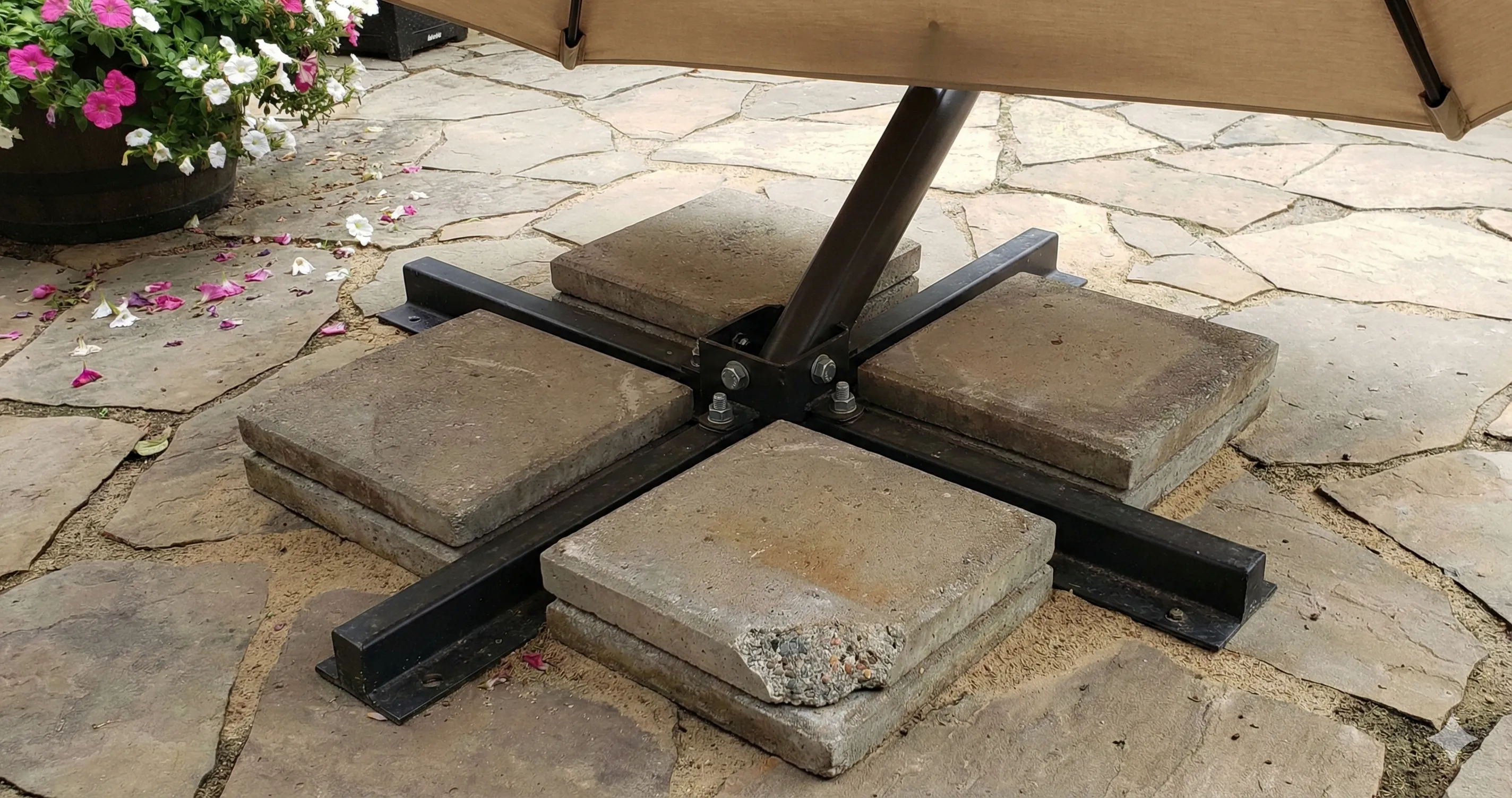
If you’re shopping for the best base for a cantilever umbrella, you’re in the right place. Offset and cantilever are the same style of umbrella, so everything here applies to both. For general base education (concrete vs cast iron vs resin, sand vs water fillable comparisons), head over to our umbrella base sizing guide.
Why the Included Base Usually Falls Short
The offset umbrella stand that ships in the box is almost always the weakest link in the setup. Manufacturers include the minimum viable base to keep shipping costs manageable, especially in the budget to mid range price points where shaving a few pounds off the package saves real money on freight.
The included base will technically hold the umbrella upright on a calm day. But “technically upright” and “confidently stable in a 15 mph gust” are two very different standards. Most included bases are 30 to 50 pounds lighter than what you’d want for regular use, and the pole collar fit is sometimes loose enough to allow noticeable wobble.
Think of the included base as a starter piece. It gets you set up on day one, but an offset umbrella base replacement is one of the smartest investments you can make for your offset umbrella setup.
The Offset Leverage Problem
Here’s what makes base selection for offset umbrellas fundamentally different from center pole market umbrellas. With a traditional umbrella, the pole runs straight through the middle of the canopy, so gravity does most of the stabilizing work.
Offset umbrellas don’t have that advantage. The canopy hangs several feet to the side of the pole, creating a lever arm that constantly tries to pull the whole thing over. The farther the canopy extends from the pole, the more force it exerts on the base.
This leverage effect means three things for base selection. First, you need proportionally more weight than a market umbrella with the same canopy size. The umbrella base weight for a 10ft offset, for example, is 175 to 225 pounds compared to roughly 50 pounds for a 10ft market umbrella. Second, weight distribution and base footprint matter as much as total pounds. A wide cross base that spreads weight across a four foot span resists tipping far better than a compact round base of equal weight. Third, the connection point between the pole and the base takes significant lateral stress, making pole diameter matching critical.
If you’re in a windy location, the leverage problem gets worse fast. Wind catching an offset canopy creates a sail effect that multiplies the tipping force. The Consumer Product Safety Commission has documented injuries from offset umbrella tipping over in moderate winds, so going heavier on the base is always the safer call.
Pole Diameter Compatibility
This is where offset umbrella base compatibility gets specific in a way that regular umbrella bases never do. Offset umbrella poles come in several standard diameters, and your base opening needs to match. A loose fit means wobble, accelerated wear, and a real risk of the pole snapping under wind load.
Common Pole Diameters
The cantilever umbrella pole size you’re working with determines which bases are even an option. Here are the standard offset umbrella pole diameter ranges you’ll encounter.
| Common Pole Diameter | Millimeters | Inches (approx) | Compatible Base Opening | Notes |
|---|---|---|---|---|
| Small (budget models) | 48mm | 1 7/8” | 48mm collar or adjustable | Common on 9ft budget offset umbrellas |
| Standard (most mid range) | 58mm | 2 1/4” | 58mm collar | The most common aftermarket size |
| Large (premium/commercial) | 76mm | 3” | 76mm collar | Found on 11ft+ premium models |
| Extra Large (13ft+ commercial) | 80mm+ | 3 1/8”+ | Brand specific | Often requires manufacturer’s own base |
How to Measure Your Pole
Wrap a flexible tape measure around the pole about six inches above the base connection point to get the circumference. Divide by 3.14 for the diameter, or use a caliper. Measure the pole itself, not any decorative sleeve over it. Write down the millimeter measurement since most base manufacturers list compatibility in millimeters.
Adapter Sleeves: When They Work
Adapter sleeves (also called reducer rings) let you fit a smaller pole into a larger base opening. They work reasonably well when bridging a small gap, say fitting a 58mm pole into a 76mm opening.
Where adapters become a compromise is when the gap is large or when the sleeve material is thin plastic rather than metal. A wobbly adapter defeats the purpose of a properly fitted base. If you’re buying an aftermarket base specifically for your offset umbrella, matching the pole diameter directly is always better than relying on an adapter.
Cross brand compatibility is a real issue with offset umbrellas. Unlike center pole umbrellas where a standard 1.5 inch pole fits almost any base, offset pole diameters vary enough between manufacturers that you can’t assume one brand’s base will fit another brand’s umbrella.
Cross Base vs Solid Base for Offset Umbrellas
When shopping for an offset umbrella base plate or stand, the geometry question comes down to cross bases versus solid bases. The cross base vs round base umbrella debate matters more for offset models than any other type because of the leverage factor.
| Base Style | Leverage Resistance | Footprint | Weight Adjustability | Trip Hazard | Best Offset Umbrella Match |
|---|---|---|---|---|---|
| Cross Base (4 arm) | Excellent | Wide (3 to 4 ft span) | High (add/remove weight plates) | Moderate (legs extend outward) | 10ft+ offset umbrellas, windy areas |
| Cross Base (3 arm) | Good | Moderate | Moderate | Lower than 4 arm | 9 to 10ft offset umbrellas |
| Round Solid Base | Fair | Compact (18 to 24 in) | None (fixed weight) | Low | Small offset umbrellas, sheltered spots |
| Square Solid Base | Fair to Good | Compact to moderate | None (fixed weight) | Low | Moderate offset umbrellas, tight spaces |
| Steel Plate Base | Good | Low profile, wide | None (fixed weight) | Very Low | Permanent or semi permanent deck setups |
The bottom line for a cross base offset umbrella setup: cross bases usually outperform solid bases at the same total weight because of the wider footprint. A heavy base for an offset umbrella doesn’t help much if all that weight is concentrated in a small circle directly under the pole. Solid bases work in sheltered locations or with smaller canopies, but for a 10 foot or larger offset in any real wind, a weighted cross base is the safer choice.
Choosing a Base by Surface Type
Where you’re placing the umbrella changes which base style works best. The surface affects stability, weight distribution, and whether you need supplemental anchoring.
| Surface Type | Recommended Base Style | Key Consideration for Offset Umbrellas | Avoid |
|---|---|---|---|
| Concrete Patio | Any freestanding base | Smooth surfaces reduce friction, so go heavier than minimum | Lightweight bases under 150 lbs |
| Wood Deck | Cross base (spreads load) or deck mount plate | Check deck weight capacity for 200+ lb bases, distribute across joists | Concentrated heavy bases on unsupported spans |
| Grass/Lawn | Cross base on pavers | Narrow bases sink into soft ground, add paver pads under each arm | Round bases directly on grass |
| Pavers | Any freestanding base | Check that base sits flat on uneven paver surfaces to prevent wobble | Assuming flat surface without checking |
| Rooftop/Balcony | Cross base or steel plate | Verify structural weight capacity before placing 200+ lbs, wind is stronger at elevation | Heavy bases without confirming building capacity |
Concrete and Stone Patios
Any freestanding base works on hard, flat surfaces. The main thing to know is that smooth concrete and polished stone are slippery, so a base that grips well on rough pavers can slide on sealed concrete. Err on the heavier side and put rubber pads under the base legs for grip.
Wood and Composite Decks
Placing an offset umbrella on a wood deck requires extra thought about weight distribution. A 200 pound round base concentrates all that load in a small area, which can stress deck boards and the joists beneath them. A cross base spreads the same weight across a wider span, ideally landing each leg over or near a joist. For permanent setups, deck mount plates that bolt directly into the framing are the most secure option. Keep in mind that the International Residential Code specifies minimum deck loads of 40 pounds per square foot, so a 200+ pound base on a small footprint can approach that limit on older construction.
Grass and Lawn
Soft ground and narrow bases don’t mix. A round solid base will slowly sink into lawn, especially after rain. Set concrete pavers under each arm of a cross base to create a stable, level platform. Ground anchors (spiral stakes that screw into the soil) work as a supplement but shouldn’t be your only strategy to stabilize a cantilever umbrella on soft ground.
Pavers
Freestanding bases generally work well on pavers. The catch is that paver surfaces aren’t always level, and even a small wobble gets amplified through the offset lever arm. Set the base in position before loading it with weight and check that all contact points sit flat. Shims or rubber pads can correct minor unevenness.
Rooftop and Balcony
Two concerns specific to elevated installations: structural capacity and increased wind exposure. A 250 pound base is a significant point load on a rooftop or balcony, so confirm with your building management that the surface can handle it. Wind speeds increase with elevation, so consider a weighted base for cantilever umbrella setups in these locations to be a safety requirement rather than an optional upgrade. Close the canopy whenever you’re not actively using it.
Quick Weight Reference
These are starting points for offset umbrella base weight. For a comprehensive table including wind zone adjustments, see our umbrella base sizing guide.
| Offset Umbrella Size | Recommended Base Weight |
|---|---|
| 9 ft | 150 to 200 lbs |
| 10 ft | 175 to 225 lbs |
| 11 ft | 200 to 250 lbs |
| 13 ft | 250 to 300+ lbs |
These numbers assume moderate wind exposure. Sheltered patios can get away with the lower end. Exposed or elevated locations should aim for the high end or above.
Signs Your Current Base Is Inadequate
Replace or upgrade your base if you notice any of these: the umbrella leans to one side even on calm days, it wobbles in light breezes, it has tipped over (even once counts), the base slides on smooth surfaces when wind picks up, or you see visible stress marks at the joint where the pole meets the base. Any of these means the next strong gust could cause real damage to the umbrella, your furniture, or someone nearby.
An offset umbrella tipping over is not just an inconvenience. A 10 foot canopy with an aluminum frame weighs 30 to 40 pounds, and that falling from height can break glass table tops, damage siding, or injure someone. If your base has failed even once, treat the upgrade as urgent.
Upgrading Your Existing Base
Before buying a completely new base, see if you can improve what you have. Adding weight bags or sandbags to cross base arms is the easiest upgrade, and most cross bases have hooks or straps designed for this. Stacking concrete pavers under and around the base adds dead weight and increases the effective footprint. For high wind situations, ratchet straps connecting the base to a nearby railing or ground anchor provide a backup that pure weight can’t match.
When should you replace instead of supplement? If the pole collar is loose and wobbling, no amount of added weight fixes that. If the base frame itself is bending or cracking, additional weight makes the problem worse. And if you need more than 75 pounds of supplemental weight to feel safe, invest in a properly sized offset umbrella base replacement from the start.
Frequently Asked Questions
Can I use a regular umbrella base for an offset umbrella?
In most cases, no. Regular umbrella bases are designed for center pole geometry where the canopy weight sits directly above the base. They’re typically far too light for offset use, and the pole opening diameter usually won’t match. You need a base specifically designed for offset or cantilever umbrellas.
Is a cross base or round base better for an offset umbrella?
A cross base is generally better for offset umbrellas. The wider footprint provides superior leverage resistance, which is exactly what offset geometry demands. Round bases can work for smaller offset umbrellas in sheltered locations, but cross bases are the safer default choice.
What pole diameter do offset umbrellas use?
Most residential offset umbrellas use 48mm or 58mm poles, with 58mm being the most common mid range size. Premium and commercial models often use 76mm or larger. Always measure your specific pole before buying an aftermarket base.
Do offset umbrella bases come with the umbrella?
Most offset umbrellas include a base, but it’s typically the minimum viable option. Budget and mid range models especially tend to include lightweight bases that work on calm days but underperform in wind. Many buyers end up upgrading within the first season.
Can I use the same base for a different brand offset umbrella?
Sometimes, but don’t assume offset umbrella base compatibility across brands. Pole diameters vary between manufacturers, and even bases with the same weight rating can have different collar sizes. Measure the pole diameter of your new umbrella and compare it to the base collar opening before attempting to reuse.
Does this apply to cantilever umbrella bases too?
Yes, completely. Offset umbrella and cantilever umbrella are two names for the same design. Everything in this guide, from pole diameter matching to leverage calculations to surface recommendations, applies identically whether the product listing says offset or cantilever.
Making Your Choice
Start with your pole diameter. That eliminates incompatible bases immediately. Then match to your surface type using the table above. Finally, target the weight range for your canopy size and adjust upward for wind exposed locations.
If you’re still choosing an offset umbrella, our offset umbrella guide covers the full picture including base compatibility. If base weight is part of your budget planning, factor in that a quality aftermarket base typically runs between $80 and $250 depending on weight class and style.
The single most common mistake with offset umbrella bases is underweighting. When in doubt, go heavier. For more guides on your outdoor setup, visit our patio umbrella resource center.