Choosing a patio umbrella comes down to six core decisions: type, size, shape, fabric, frame material, and features. Get these six right and you end up with an umbrella that fits your space, handles your weather, and lasts for years. Miss one and you are shopping again next season.
Whether you are upgrading a faded canopy, outfitting a brand-new patio, or standing in the store trying to decide between two models, this guide walks you through every decision that affects how your umbrella performs, how long it lasts, and whether you will be happy with it a year from now. A patio umbrella is one of the most used pieces of outdoor furniture you will own, so picking the right one saves you money and frustration. Below, you will find a clear framework for choosing based on your space, your climate, and how you actually use your outdoor living area.
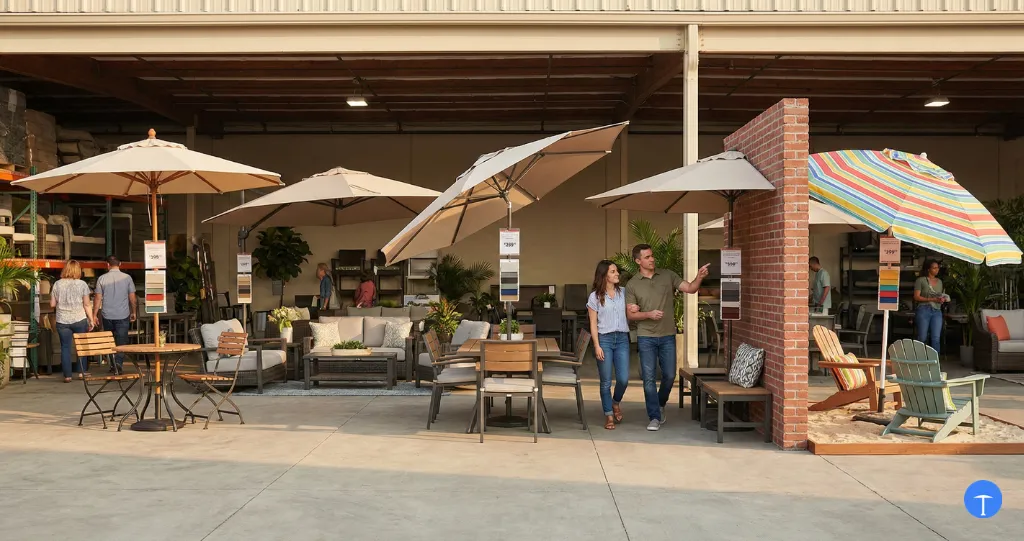
What Type of Patio Umbrella Should You Choose?
The best patio umbrella type depends on your table setup and available space. Market umbrellas work best for standard dining tables, cantilever umbrellas are ideal for lounge areas without center-table setups, and half umbrellas solve the problem of tight balconies or wall-adjacent patios. Here is how each type compares.
Market Umbrellas
Market umbrellas, also called center-pole umbrellas, are the classic design. The pole runs through the center of the canopy and typically slides through a hole in your patio table. They are the most affordable, most widely available, and simplest to set up. If you have a standard patio table with a center hole, a market umbrella is the most practical starting point. For top-rated models, see our guide to the best market umbrellas.
Cantilever Umbrellas
Cantilever umbrellas, sometimes called offset umbrellas, position the pole to the side so the canopy floats freely overhead. This means no pole in the middle of your seating area, which is ideal for sectional sofas, lounge chairs, or any setup where a center pole would get in the way. They offer more flexible shade positioning but cost more, weigh more, and require a heavier base. Our best cantilever umbrellas guide covers the top options.
Half and Wall Umbrellas
Half umbrellas sit flush against a wall or railing, making them perfect for small balconies, narrow patios, or spaces where a full round canopy would extend beyond your area. They provide less total shade than a full umbrella but solve a real problem for tight spaces. If you are working with a compact balcony, see our guide to the best patio umbrella for a small balcony for more options.
| Umbrella Type | Best For | Price Range | Pros | Cons |
|---|---|---|---|---|
| Market (Center Pole) | Standard patio tables, everyday use | $40–$400 | Affordable, stable, widely available, many tilt options | Pole in center of table, less shade flexibility |
| Cantilever (Offset) | Lounge areas, sectionals, poolside | $150–$800+ | No center pole, flexible positioning, large canopy options | Heavier, needs heavy base, higher cost |
| Half/Wall | Small balconies, wall-adjacent patios | $50–$200 | Space saving, flush to wall, good for renters | Less total shade, fewer size options |
| Tilt (Push/Crank/Auto) | Patios with shifting sun angles | $60–$500 | Adjustable shade angle, tracks the sun | More moving parts, tilt mechanisms vary in quality |
What Size Patio Umbrella Do You Need?
Your patio umbrella should extend at least two feet beyond each side of the area you want to shade. For a four-person round dining table, a 7 to 9 foot umbrella usually works. For a six-person rectangular table, look at 9 to 11 feet. A canopy that is too small leaves you baking at the edges, while one that is too large can catch wind and overwhelm a small patio.
Measure your table or seating area first, then match it to umbrella size. Our detailed patio umbrella size chart breaks this down with exact dimensions for every common table size. If you are unsure what base size to pair with your umbrella, our base sizing guide covers the weight and width recommendations.
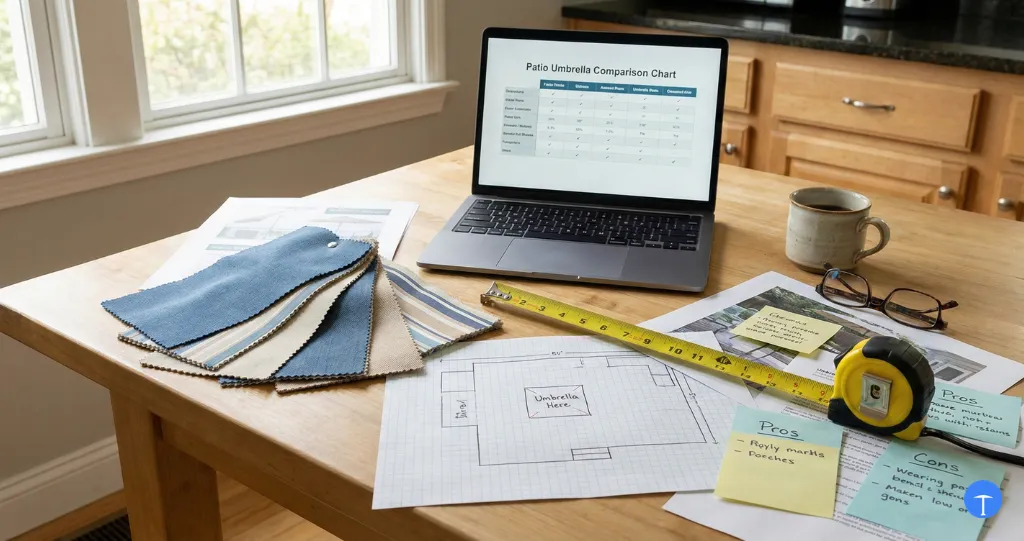
What Shape Patio Umbrella Is Best for Your Space?
Round umbrellas are the best choice for standard circular or square dining tables, while rectangular umbrellas provide better coverage for elongated tables and narrow patios. Square and octagonal canopies split the difference and work well for both dining and lounge setups. Here is how to match umbrella shape to your layout.
Round and Octagonal
Round umbrellas (including octagonal canopies, which are technically round with flat edges) are the most common shape on the market. They distribute shade evenly in all directions, making them ideal for round, square, and small rectangular tables. If your table seats four people or fewer and is roughly symmetrical, a round canopy is the simplest match.
Rectangular and Oval
Rectangular umbrellas provide directional shade coverage that follows the shape of longer tables. A 6 by 10 foot rectangular canopy covers a six-seat dining table far more efficiently than a round umbrella of similar area. If you have a rectangular table or a narrow patio, a rectangular umbrella eliminates wasted overhang on the short sides while maximizing coverage along the length.
Square
Square umbrellas offer a modern look and fit well over square tables and smaller seating groups. They provide slightly more shade coverage than an equivalent-diameter round umbrella because the corners extend farther. Square canopies are especially common on cantilever models and commercial-grade setups.
| Shape | Best For | Coverage Pattern | Common Sizes | Availability |
|---|---|---|---|---|
| Round/Octagonal | Round and square tables, general use | Even, all directions | 7 ft, 9 ft, 11 ft | Most widely available |
| Rectangular | Long dining tables, narrow patios | Directional, length-focused | 6x10 ft, 8x11 ft | Moderate availability |
| Square | Square tables, modern patios, commercial use | Even with extended corners | 8x8 ft, 10x10 ft | Common on cantilevers |
Which Patio Umbrella Fabric Lasts the Longest?
Sunbrella solution-dyed acrylic is the longest-lasting patio umbrella fabric, providing 98%+ UV protection and 5 to 10 years of fade resistance. Olefin is a strong mid-range alternative, while solution-dyed polyester offers decent durability at a lower price point. Basic piece-dyed polyester is the most affordable but fades noticeably within one to two seasons. Here is how every major fabric type compares.
Polyester
Polyester is the most common and most affordable umbrella fabric. Basic polyester blocks around 90% of UV rays and comes in a wide range of colors. The downside is fade resistance. Standard piece-dyed polyester can fade noticeably after just one or two seasons in direct sun. Solution-dyed polyester holds color much longer because the dye is baked into the fiber during manufacturing. If polyester is in your budget, always look for solution-dyed.
Olefin
Olefin is a step up from basic polyester. It is inherently fade resistant, dries quickly, and resists mold and mildew better than polyester. Olefin is a good middle ground if you want improved durability without jumping to acrylic pricing. You will find it on mid-range outdoor shade umbrellas from brands that take fabric performance seriously.
Acrylic and Sunbrella
Acrylic fabric, especially the Sunbrella brand, is the gold standard for outdoor umbrella canopies. Sunbrella is a solution-dyed acrylic made by Glen Raven that blocks over 98% of UV rays and resists fading for 5 to 10 years. It carries a manufacturer warranty and comes in hundreds of colors and patterns. Our full explainer on what Sunbrella fabric is covers the manufacturing process and warranty details. If you are comparing Sunbrella to standard options, see our Sunbrella vs regular fabric comparison.
| Fabric Type | UV Protection | Fade Resistance | Water Resistance | Lifespan | Price Level |
|---|---|---|---|---|---|
| Polyester (basic) | 85–90% | Low (1–2 seasons) | Moderate | 1–3 years | $ |
| Polyester (solution-dyed) | 90–95% | Moderate (3–4 seasons) | Moderate | 3–5 years | $$ |
| Olefin | 90–95% | Good (4–6 seasons) | Good, dries fast | 4–6 years | $$ |
| Acrylic | 95–98% | Very Good (5–8 seasons) | Good with treatment | 5–8 years | $$$ |
| Sunbrella | 98%+ | Excellent (5–10+ years) | Excellent (fluorocarbon finish) | 7–10+ years | $$$$ |
What Frame Material Is Best for Patio Umbrellas?
Powder-coated aluminum is the best patio umbrella frame material for most buyers because it is lightweight, rust-proof, low maintenance, and compatible with every tilt mechanism. Wood frames offer superior aesthetics but require annual upkeep. Steel frames add weight and rigidity but can rust if the coating chips. For the ribs that support the canopy, fiberglass outperforms aluminum in any location with regular wind.
Aluminum Frames
Aluminum is the most popular frame material for good reason. It is lightweight, rust resistant, affordable, and compatible with every type of mechanism from push-button tilt to auto tilt. Powder-coated aluminum adds extra weather protection and comes in various finishes. For most buyers, aluminum is the practical default. Our aluminum vs wood patio umbrella comparison has the full breakdown.
Steel Frames
Steel frames are heavier and more rigid than aluminum. You will find them on commercial-grade umbrellas and budget models alike. The key concern is rust. Powder-coated steel holds up well, but any chip in the coating becomes a rust entry point. Steel is best for sheltered locations or commercial settings where weight equals stability.
Wood Frames
Wood frames, typically teak, eucalyptus, or shorea, deliver a natural aesthetic that aluminum cannot match. They are heavier, require annual oiling or sealing, and usually support only pulley opening systems rather than crank mechanisms. If your patio has a warm, natural design theme and you are willing to do the upkeep, wood is beautiful. If low maintenance is a priority, aluminum is a better fit.
Fiberglass Ribs
Ribs are the structural spokes that support the canopy, and rib material matters at least as much as pole material. Fiberglass ribs flex in wind and return to shape, while aluminum ribs bend permanently. If you live in any area with regular wind, fiberglass ribs are worth the small price premium. Our detailed aluminum vs fiberglass umbrella ribs comparison explains the failure-mode differences.
| Frame Material | Weight | Durability | Rust Resistance | Maintenance | Price Level |
|---|---|---|---|---|---|
| Aluminum | Light (5–12 lbs) | Good | Excellent (no rust) | Low: occasional wipe | $$ |
| Steel (powder-coated) | Heavy (10–20 lbs) | Very Good | Good if coating intact | Low–Medium: inspect coating | $–$$ |
| Wood (eucalyptus/teak) | Heavy (12–25 lbs) | Good to Excellent | N/A (wood rots if neglected) | High: annual oil/seal | $$$–$$$$ |
| Fiberglass (ribs only) | Light | Excellent (flexes back) | Excellent | None | +$20–$50 over aluminum ribs |
Which Tilt Mechanism Is Best for a Patio Umbrella?
Auto tilt is the best tilt mechanism for most patio umbrella buyers because it provides smooth, continuous angle adjustment from a seated position using the crank handle. Push-button tilt is the most affordable option but requires you to stand up. Crank tilt is a mid-range choice with limited preset angles. Here is how all four tilt types compare.
Push-Button Tilt
The simplest and most affordable tilt system. You press a button on the pole and manually push the canopy to the desired angle. It works fine but requires you to stand up and reach the pole. Found on most entry-level market umbrellas.
Crank Tilt
Crank tilt combines the opening crank with a tilt function. You crank the umbrella open, then continue cranking to engage the tilt. It is more convenient than push-button since you stay seated, though the tilt positions are usually limited to a few preset angles.
Auto Tilt
Auto tilt allows you to adjust the canopy angle continuously by turning the crank handle. You get smooth, precise angle control without preset stops. This is the most user-friendly tilt option and is standard on mid-range to premium market umbrellas. For a deeper look at mechanism differences, see our guide to understanding umbrella tilt mechanisms.
Collar Tilt
Collar tilt uses a ring or collar on the pole that you twist to adjust the angle. It offers smooth adjustment similar to auto tilt but operates independently of the opening mechanism. Less common but effective, especially on wood-frame umbrellas.
| Tilt Mechanism | Ease of Use | Adjustment Range | Can Stay Seated? | Price Level | Best For |
|---|---|---|---|---|---|
| Push-Button Tilt | Basic — manual push | Limited preset angles | No | $ | Budget umbrellas, occasional use |
| Crank Tilt | Moderate — crank operated | Few preset angles | Yes | $$ | Mid-range, regular use |
| Auto Tilt | Best — continuous smooth | Full continuous range | Yes | $$–$$$ | Daily use, sun tracking |
| Collar Tilt | Good — twist collar | Smooth range | Partial (reach pole) | $$–$$$ | Wood frames, design-focused setups |
Do Vented Canopies Make a Difference?
Yes, vented canopies significantly improve wind stability. A vented canopy has an opening near the top of the umbrella, usually covered by a second layer of fabric, that allows hot air and wind to pass through rather than building up underneath and pushing the umbrella over. In any area where you get afternoon breezes or occasional gusts, a vented canopy reduces the chance of tipping dramatically.
The trade-off is minimal. Vented umbrellas block slightly less rain in a downpour, but since most people close their umbrella during heavy rain anyway, this rarely matters. If wind is a real concern for your area, our wind-resistant umbrella guide covers additional features to look for.
How Does Canopy Color Affect UV Protection?
Dark-colored canopies like navy, black, and forest green block slightly more UV radiation than light colors, but the difference is modest. Fabric quality matters far more than color for overall sun protection. A Sunbrella canopy in a light color will block more UV and outlast a cheap polyester canopy in a dark color every time.
Dark canopies absorb more heat and can make the area around the umbrella feel warmer. Light colors reflect heat and create a brighter feel underneath but let marginally more UV through. For most people, the difference is small enough that you should choose a color you enjoy looking at. If maximum UV protection is your top priority, such as for a children’s play area or a spot where someone with sun sensitivity sits daily, go darker and pair it with high-quality fabric.
How to Wind-Proof Your Patio Umbrella
Wind is the number one cause of patio umbrella damage. Four features make a meaningful difference, in order of importance. First, a vented canopy lets wind pass through instead of catching like a sail. Second, fiberglass ribs flex and recover where aluminum ribs bend permanently. Third, a thicker pole of 1.5 inches or more resists bending at the joint. Fourth, a properly weighted base keeps everything anchored.
If your patio gets regular wind, prioritize all four features. A wind-resistant outdoor umbrella setup with a vented canopy, fiberglass ribs, a thick pole, and a heavy base will handle conditions that would destroy a standard setup. For comprehensive wind-proofing advice, see our guide to the best patio umbrella for windy areas.
Red Flags: What to Avoid When Buying a Patio Umbrella
Not all umbrellas are built equally, and the cheapest options often cost you more in the long run. Avoid umbrellas with thin aluminum ribs (they will bend in the first strong gust), unmarked fabric with no UV rating, plastic tilt mechanisms (they strip and break quickly), and poles thinner than 1.38 inches.
Also be cautious with any umbrella that does not list its fabric type or frame material in the product description. Reputable manufacturers are transparent about materials because they have nothing to hide. If a product listing is vague about what the umbrella is made of, that vagueness is telling you something. Always check the product specs before purchasing, and when possible, buy from brands that publish their UPF ratings and fabric certifications.
Frequently Asked Questions
What is the best material for a patio umbrella?
For the canopy, Sunbrella solution-dyed acrylic offers the best combination of UV protection, fade resistance, and longevity. For the frame, powder-coated aluminum is the best balance of durability, weight, and value for most buyers. If you want the strongest ribs, choose fiberglass over aluminum.
How long should a good patio umbrella last?
A quality patio umbrella with an aluminum frame and Sunbrella fabric should last 7 to 10 years with normal use and basic care. Budget umbrellas with standard polyester canopies typically need replacing every 1 to 3 years. Our cost guide breaks down what you can expect at each price tier.
Do I need a tilt mechanism on my patio umbrella?
If your patio gets sun from changing angles throughout the day, yes. A tilt mechanism lets you angle the canopy to follow the sun, dramatically increasing useful shade hours. Auto tilt is the most convenient option for regular use.
What color patio umbrella blocks the most sun?
Darker colors like navy, black, and forest green absorb more UV radiation and provide slightly better UV protection underneath. The difference is modest, though. Fabric quality and UPF rating matter more than color for overall UV-blocking performance.
Can I leave my patio umbrella outside all year?
It depends on your climate and the umbrella’s build quality. In mild climates, a quality umbrella with Sunbrella fabric and an aluminum frame can stay outside year-round if you close it when not in use. In areas with heavy snow, freezing rain, or sustained high winds, store your umbrella indoors or in a weatherproof cover during the off-season to extend its lifespan significantly.
Your Buying Checklist
Before you buy, work through these questions and you will have everything you need to choose confidently:
What is your table or seating layout? This determines type and size.
How much space do you have? Measure the area and allow for 2 feet of overhang on each side.
What shape is your table? Match round tables to round umbrellas and rectangular tables to rectangular canopies.
What is your local weather like? Wind, sun intensity, and rain frequency shape your feature needs.
How much maintenance are you willing to do? This determines frame material.
How long do you want it to last? This determines fabric quality.
Do you need tilt? Track your sun angles for a day before deciding.
What is your budget? Set a range and compare the best options within it.
Does the manufacturer list materials clearly? If not, keep looking.
Take your time with these answers, match them to the recommendations above, and you will end up with a patio shade solution that earns its spot on your patio for years to come. For a complete overview of all umbrella types and their parts, visit our patio umbrella homepage.