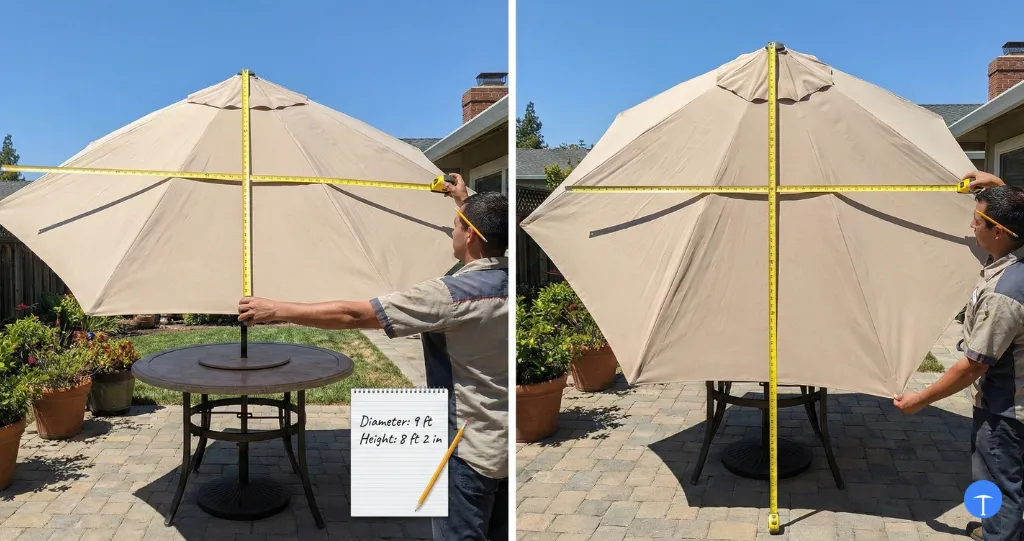
To measure a patio umbrella, take three measurements: canopy diameter (edge to edge across the open canopy), pole height (base to finial), and pole diameter (width across the pole). These three numbers determine which umbrella fits your table, base, and outdoor space.
Whether you are replacing an existing umbrella, shopping for your first one, or trying to figure out if that 9-footer at the store will actually cover your table, this patio umbrella measurement guide walks you through every step. We explain the sizing formulas that professionals use and help you match those numbers to the right outdoor umbrella for your setup. If you already know what you need and want to jump to a size recommendation, use our patio umbrella size chart for a quick reference.
What This Guide Covers
This is the central hub for everything related to measuring and sizing patio umbrellas. The sections below cover measuring your existing umbrella, your table, and your outdoor space. For specific sizing scenarios, we have dedicated guides that go deeper:
- Patio Umbrella Size Chart — Full reference table matching umbrella sizes to tables, seating capacity, and shade coverage
- What Size Umbrella Base Do I Need — Weight and sizing guide for umbrella bases by canopy size and wind conditions
- Umbrella Size for 4-Person Table — Exact sizing for round, square, and rectangular 4-seat dining sets
- Umbrella Size for 6-Person Table — Coverage guide for larger oval, rectangular, and round 6-seat setups
- How Much Does a Patio Umbrella Cost — 2025 price ranges by type, size, and quality tier
Start here for the measurement fundamentals, then use the guides above for your specific situation.
Why Proper Measurements Matter
An undersized umbrella defeats the purpose of having one. You end up chasing shade by moving chairs around, and by mid-afternoon the sun angle shifts and nobody is covered. An oversized umbrella creates a different problem: it catches more wind, needs a heavier base, and can overwhelm a small patio visually.
Getting the measurements right before you buy saves you the hassle of returns and the disappointment of inadequate umbrella shade coverage. Patio umbrellas are sized by canopy diameter (the measurement across the open canopy from edge to edge), but that single number only tells part of the story. Pole height, pole diameter, your table size, and your overall space dimensions all factor into finding the right outdoor umbrella fitting for your setup. The Skin Cancer Foundation recommends seeking shade as a primary UV protection strategy, which is worth keeping in mind as motivation to get your umbrella sizing right.
How to Measure an Existing Patio Umbrella
If you are replacing a patio umbrella or ordering a replacement umbrella canopy measurement, you need three measurements from your current setup.
Measuring Canopy Diameter
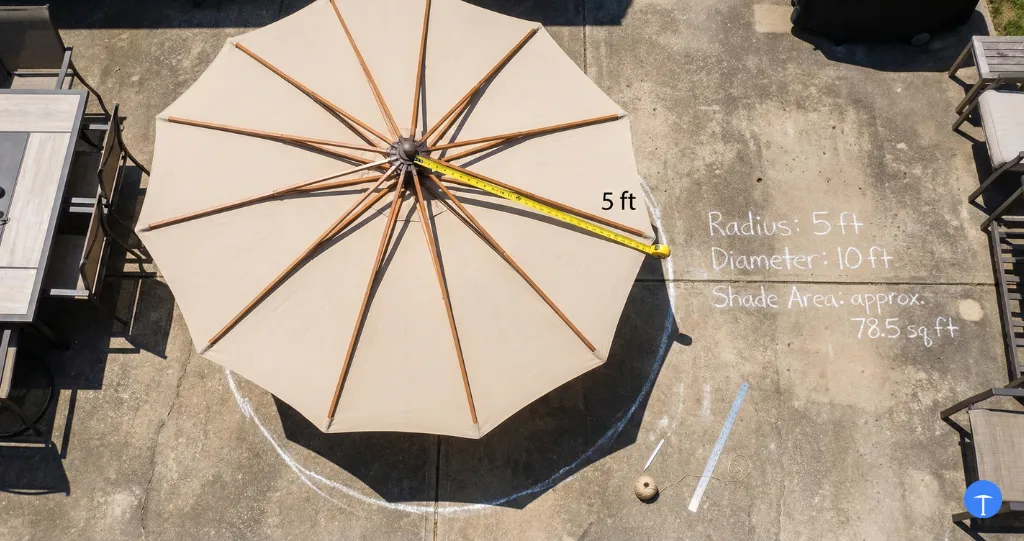
Open the umbrella fully and measure the umbrella canopy straight across from one edge to the opposite edge, passing through the center pole. For round umbrellas, any straight line through the center gives you the umbrella canopy diameter. For octagonal umbrellas (which most “round” patio umbrellas actually are), measure from the tip of one panel to the tip of the panel directly opposite. This measurement is your canopy diameter, and it is the number manufacturers use when they say “9-foot umbrella” or “11-foot umbrella.”
If the umbrella is closed or you are measuring one in a store, look for the size on the product tag or box. Never estimate based on the folded canopy length because that measurement has no reliable correlation to the open diameter.
Measuring Pole Height
Measure from the bottom of the pole (where it enters the base or table hole) to the top of the finial (the decorative cap at the top). Standard market umbrella poles run between 7.5 and 9 feet tall. If you are using a table-mounted setup, the key clearance number is from the canopy edge to the head of the tallest seated person. You want at least 6 inches above their head so nobody feels like they are ducking under a low ceiling. For most adults, this means the canopy edge should sit roughly 36 to 40 inches above the tabletop.
Measuring Pole Diameter
The umbrella pole size determines which bases and table holes your umbrella fits into. Use a tape measure or calipers to measure straight across the pole at its widest point. Common residential pole diameters are 1.5 inches (38mm) and 1.89 inches (48mm). Commercial poles run larger, typically 2 to 3 inches. This measurement must match your patio table umbrella hole size and your base opening, so write it down before shopping. If there is a small gap between pole and hole, you can use a reducer ring (most umbrellas include one), but you cannot fix a pole that is too large for the hole.
How to Measure Your Table for an Umbrella
Your table dimensions are the starting point for choosing the right umbrella size. The core formula: add 4 to 5 feet to your table’s longest dimension to get the ideal umbrella diameter. This gives you 2 to 2.5 feet of patio umbrella overhang on each side, enough to shade the people sitting at the table, not just the plates. The full sizing formula is broken down step by step in the section below.
Round and Square Tables
Measure straight across the widest point. For a round table, that is the diameter. For a square table, measure one side. A 48-inch round table paired with the 4-to-5-foot rule means you want a patio umbrella between 8 and 9 feet. Since 8 feet is not a standard patio umbrella size, you would go with a 9-footer, which happens to be the most common residential umbrella size sold. For specific recommendations for your table setup, see our guides for umbrella sizing for 4-person tables and 6-person tables.
Rectangular and Oval Tables
Measure both length and width. Rectangular tables are trickier because a standard round umbrella may not provide edge-to-edge coverage along the longer dimension. For a 72 × 42-inch rectangular table, you would ideally want an 11-foot umbrella to shade the ends. When that is not practical, you have two options: position a large round umbrella to cover the center area and accept reduced coverage at the far ends, or look into a rectangular cantilever umbrella that matches the table shape. Some homeowners with large rectangular tables use two smaller umbrellas spaced along the table length.
The Umbrella Hole
If your table has a center umbrella hole, measure its diameter. Standard holes are 1.5 to 2.5 inches across. Note whether the hole sits dead center or is offset. A centered hole works with market (center pole) umbrellas. If your table does not have a hole, or if the hole position limits shade coverage, a cantilever (offset) umbrella is your best bet because the pole sits to the side and the canopy extends over the table without needing a center mount. For more on the structural differences between these types, see our guide to parts of a patio umbrella.
How to Measure Your Outdoor Space
Before you focus on the umbrella alone, you need to know how much room you are working with. An umbrella that is perfect for your table can still be wrong for your space if it bumps against a wall, overhangs a railing, or blocks a walkway.
Measure the total patio, deck, or balcony area in both directions. Then map out where your table and chairs sit, including the space chairs occupy when pulled out (add about 24 inches behind each chair). The umbrella canopy, when open, should stay within the usable footprint of your space with a few inches of clearance on all sides. Overhead clearance matters too. Check for eaves, pergola beams, hanging lights, ceiling fans, or tree branches. You need at least 7.5 feet of vertical clearance from the ground to the underside of the open canopy for comfortable movement underneath.
If you are working with a small balcony or a tight corner patio, our comparison of round vs square patio umbrellas covers how different shapes use space in very different ways.
Quick Sizing Reference Table
Use this table as a starting point. Match your table measurement to the recommended umbrella size, then adjust based on your specific space constraints and sun exposure. For the full breakdown with shade coverage calculations and overhang recommendations by umbrella dimensions, see the detailed sizing reference.
| Table Type | Table Size | Umbrella Size | Seats | Shade (sq ft) |
|---|---|---|---|---|
| Round | 36–42 in | 7 – 7.5 ft | 2–4 | ~38–44 |
| Round | 42–48 in | 9 ft | 4 | ~64 |
| Round | 48–54 in | 9–10 ft | 4–6 | ~64–79 |
| Round | 54–60 in | 10–11 ft | 6 | ~79–95 |
| Square | 36–42 in | 7.5–9 ft | 4 | ~44–64 |
| Rectangle | 48 × 30 in | 7.5–9 ft | 4 | ~44–64 |
| Rectangle | 60 × 36 in | 9–10 ft | 4–6 | ~64–79 |
| Rectangle | 72 × 42 in | 10–11 ft | 6 | ~79–95 |
| Rectangle | 84 × 42 in | 11–13 ft | 6–8+ | ~95–133 |
The Sizing Formula Step by Step
Professional outdoor designers use a reliable five-step process to size patio umbrellas. Here is the umbrella sizing formula applied step by step.
Step 1: Measure your table’s widest dimension. For round tables, that is the diameter. For rectangular tables, use the length. Write this number down in inches.
Step 2: Add 48 to 60 inches (4 to 5 feet). This accounts for the overhang needed to shade seated guests. The extra coverage means 2 to 2.5 feet of canopy extends past the table edge on each side.
Step 3: Convert to feet and round to the nearest standard size. Umbrellas come in fixed sizes (6, 7, 7.5, 9, 10, 11, 13 feet), so round your calculation to the closest option. When in doubt, round up. A little extra shade never hurts, while a little less always does.
Step 4: Check your space constraints. Make sure the umbrella diameter fits within your patio footprint with clearance. If space is tight, you may need to accept the smaller option or choose a half umbrella or wall-mounted design.
Step 5: Factor in base requirements. Larger umbrellas need heavier bases for stability. As a rule of thumb, plan on 10 pounds of umbrella base weight per foot of canopy diameter. A 9-foot umbrella needs at least a 90-pound base in calm conditions, and more if you get regular wind. Our guide on choosing the right umbrella base weight covers this in detail.
Market vs Cantilever: Measuring Differences
Market umbrellas and cantilever umbrellas are measured differently, and this trips up a lot of buyers.
A market umbrella’s size is the canopy diameter, and the pole goes through the center. When you place a 9-foot center pole umbrella over a table, the canopy is centered directly above. The shade footprint is roughly symmetrical around the pole.
A cantilever (offset) umbrella hangs from a side-mounted arm. The canopy diameter is measured the same way, but the shade footprint is entirely offset from the base. This means a 10-foot cantilever can cover a table that sits 5 or more feet away from the base. The offset umbrella measurement you need to pay extra attention to is the arm reach (how far the canopy center sits from the support pole) and the rotation range (whether the canopy can swing to adjust for sun angle).
Cantilevers also require significantly heavier bases, often 150 to 250+ pounds, because of the leverage created by the offset design. For a full comparison of these styles, browse our collections of market umbrellas and cantilever umbrellas.
Common Measurement Mistakes
These are the sizing mistakes that come up again and again with patio umbrella buyers.
Measuring the table and buying that same size umbrella. A 48-inch table with a 48-inch umbrella means the shade line falls right at the table edge. Nobody sitting at the table is actually in the shade. You always need the overhang accounted for in the formula above.
Forgetting that the sun moves. An umbrella that provides perfect shade at noon will leave one side exposed by 3 PM as the sun angle drops. This is why the overhang formula builds in extra coverage. If your outdoor dining tends to happen in late afternoon, consider a tilt mechanism umbrella or a cantilever that can rotate and adjust.
Ignoring the pole diameter. Buying a beautiful umbrella only to discover the pole does not fit your table hole or existing base is frustrating. Always measure pole diameter before purchasing.
Not accounting for wind. A larger canopy catches more wind. If you are in a windy location, you need a heavier base, and you might want to explore wind-resistant umbrella options with features like vented canopies and fiberglass ribs.
Measuring the folded umbrella. The closed length of an umbrella tells you very little about its open canopy diameter. A 9-foot umbrella might only be 5 feet long when closed. Always reference the manufacturer’s stated umbrella dimensions or measure the open canopy yourself.
Frequently Asked Questions
What size patio umbrella do I need for my table?
Take your table’s widest measurement and add 4 to 5 feet. That total is your ideal umbrella diameter. For example, a 48-inch (4-foot) round table needs an 8-to-9-foot umbrella, so you would buy the standard 9-foot size. For the full breakdown by every table shape and dimension, see our patio umbrella size chart.
Do I measure a patio umbrella open or closed?
Always measure open. The closed or folded length of a patio umbrella does not correspond to the canopy diameter in any standard way. A 9-foot umbrella could measure anywhere from 4.5 to 6 feet when closed, depending on the pole design and canopy fold. The only reliable measurement is the open canopy diameter.
What is the most common patio umbrella size?
The 9-foot umbrella is the most common standard patio umbrella size for residential use. It pairs well with tables between 42 and 48 inches across, which covers the majority of 4-person round and square dining sets. For larger tables seating 6 or more, 10-foot and 11-foot umbrellas are the standard choices.
How much overhang should a patio umbrella have?
Aim for 2 to 2.5 feet of overhang past the table edge on all sides. This coverage ensures that people sitting at the table are fully shaded, not just the table surface. Less than 2 feet of overhang means the shade line will fall on or near the chair backs, leaving shoulders and arms exposed, especially as the sun moves through the afternoon.
What pole diameter fits a standard patio table?
Most residential patio tables have umbrella holes sized for 1.5-inch or 1.89-inch diameter poles. Commercial tables often accommodate 2-to-3-inch poles. Measure your table hole before buying. If there is a minor gap between the pole and the hole, a plastic reducer ring (usually included with the umbrella) will snug the fit. If the pole is larger than the hole, it simply will not work.
Putting It All Together
Measuring for a patio umbrella comes down to three key numbers: canopy diameter, pole height, and pole diameter. Take those measurements, apply the overhang formula from the sizing steps above, and round to the nearest standard umbrella size.
From here, your next step depends on where you are in the buying process. For specific size-to-table matches, use the patio umbrella size chart. If you already know your size and need the right base, see what size umbrella base you need. And if you are weighing quality tiers, our patio umbrella cost guide breaks down where your money goes the furthest.
The time you spend measuring now saves you from the two most common outdoor furniture regrets: returning an umbrella that does not fit, and living with shade that does not cover. Explore the full patio umbrella guide for everything else you need to know before buying.