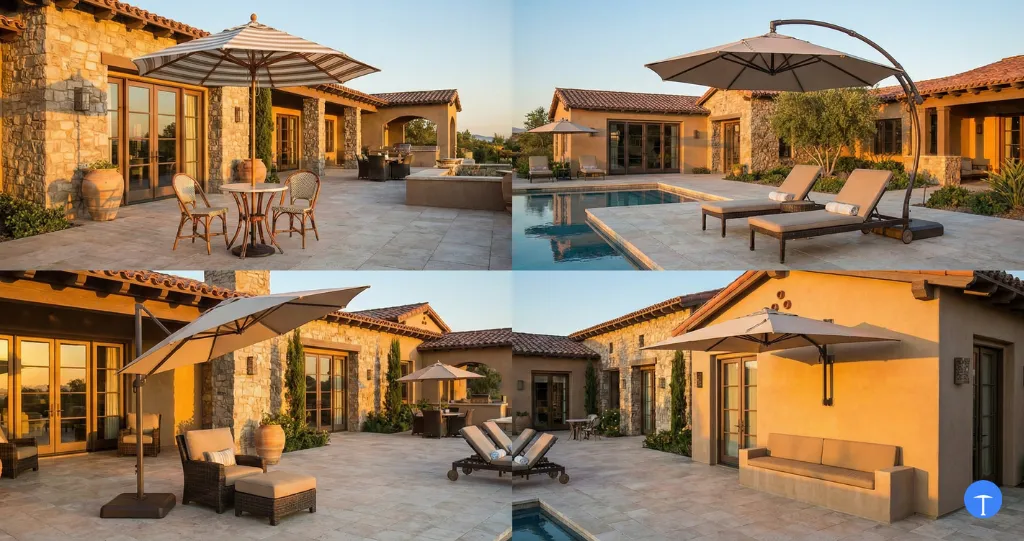
Choosing the right type of patio umbrella comes down to three things: your space, your table setup, and how much shade you actually need. There are six main types of patio umbrellas, from the classic center pole market umbrella to offset cantilevers, half wall models, and commercial grade options, and each one is designed for a specific situation. Pick the wrong type and you end up with an umbrella that blocks your view, wobbles in a breeze, or simply does not fit where you need it.
This guide walks you through every patio umbrella style, shape, and mechanism so you can narrow down the right match without second guessing yourself.
Why Umbrella Type Matters
Not all patio umbrellas are built the same way, and the type you choose affects everything from how much shade you get to how stable the umbrella is in wind. A market umbrella with a center pole is a completely different product than a cantilever with a side mounted arm, even if both provide roughly the same amount of shade.
The type also determines what kind of base you need, whether you can use it with a table, how easy it is to adjust, and how much you will spend. A $60 market umbrella and a $400 cantilever solve different problems. Understanding the categories first saves you from buying something that looks great online but does not work in your actual space.
If you are new to patio umbrellas, it helps to know the basic parts of a patio umbrella before diving into types. That said, you do not need a technical background to follow along here.
Patio Umbrella Types at a Glance
| Umbrella Type | How It Works | Common Sizes | Typical Price Range | Best For |
|---|---|---|---|---|
| Market (Center Pole) | Straight pole through a table hole or freestanding base | 7 ft to 11 ft | $40 to $250 | Dining tables, everyday backyard use |
| Cantilever (Offset) | Side pole with suspended canopy, no center obstruction | 9 ft to 13 ft | $150 to $600 | Poolside, large seating areas, lounge setups |
| Half/Wall | Half circle canopy sits flush against a wall or railing | 7 ft to 9 ft | $50 to $150 | Balconies, narrow patios, against house walls |
| Beach | Lightweight pole with pointed end for sand | 6 ft to 8 ft | $20 to $80 | Sand, grass, temporary portable shade |
| Commercial/Restaurant | Heavy duty frame, larger canopy, wind rated | 9 ft to 16 ft | $300 to $2,000+ | Restaurants, cafes, hotels, public spaces |
| Freestanding (No Table) | Center or offset pole with weighted base, no table required | 7 ft to 13 ft | $50 to $500 | Pool decks, lounge chairs, garden seating |
This table gives you the overview, but the real differences show up when you look at each type in detail.
Market Umbrellas (Center Pole)
Market umbrellas are the most common type of patio umbrella you will find, and there is a reason for that. They are simple, affordable, and work with nearly any outdoor dining table that has an umbrella hole. The design is straightforward: a single center pole runs straight through the middle of the table, supporting the canopy above.
Most market umbrellas range from 7 feet to 11 feet in diameter, with 9 foot models being the most popular residential size. They weigh between 10 and 25 pounds depending on materials, making them easy to set up and take down. Prices start around $40 for a basic aluminum model and go up to $250 or more for wood pole versions with premium Sunbrella fabric.
The center pole is both the strength and the limitation. It provides solid stability, especially in moderate wind, because the weight is distributed evenly. But it also means the pole sits right in the middle of your table, which can get in the way during meals or conversations. If you plan to use a patio umbrella without a table, a market umbrella in a freestanding base works, but you will always have that pole in the center of your shade area.
Market umbrellas are the right choice when you have a standard dining table for 4 to 6 people and want reliable shade without spending a lot. For a deeper look at top rated options, check out our best market umbrellas guide.
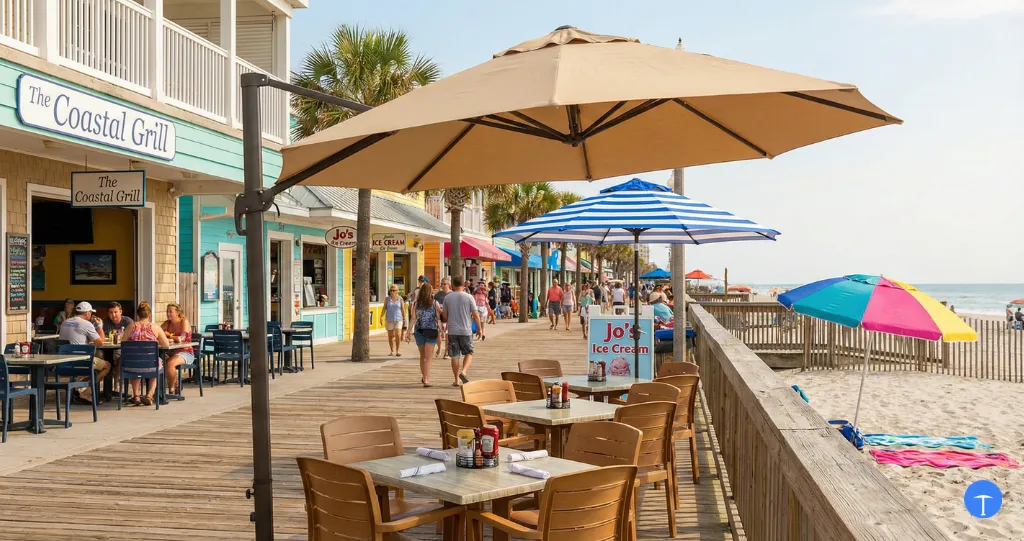
Cantilever and Offset Umbrellas
A cantilever umbrella, also called an offset patio umbrella, moves the support pole to the side. Instead of running through the center, the pole sits next to your seating area and an arm extends out to suspend the canopy overhead. This gives you a completely open space underneath with no pole in the way.
That design freedom comes at a cost. Cantilever umbrellas typically start around $150 and run up to $600 or more for larger models with 360 degree rotation and multi position tilt. They are also heavier, with most models weighing 40 to 80 pounds before you add the base. And the base itself needs to be significantly heavier than a market umbrella base, often 100 pounds or more, to counterbalance the offset weight. Our guide on what size umbrella base you need covers the specifics.
Common sizes range from 9 feet to 13 feet, with 10 and 11 foot models being the sweet spot for residential use. The larger canopy combined with the offset design makes cantilevers ideal for covering lounge chairs by the pool, L shaped sectional sofas, or large dining setups where a center pole would be awkward.
The trade off is stability. Because the canopy hangs to one side, cantilever umbrellas are more vulnerable to wind than center pole designs. Most manufacturers recommend closing them when winds exceed 20 to 25 mph. If you live somewhere breezy, a vented canopy model helps, but a cantilever will never match a market umbrella for raw wind resistance.
Cantilevers are worth the investment when you need flexible shade positioning over a large area and you do not want a pole in the middle of your space. Browse our best cantilever umbrellas to compare top options.
Half and Wall Mounted Umbrellas
Half umbrellas, sometimes called wall umbrellas or balcony umbrellas, use a flat back edge that sits flush against a wall, railing, or fence. The canopy is a half circle rather than a full circle, which means the umbrella takes up roughly half the floor space of a standard market model.
These are purpose built for tight spaces. If you have a small apartment balcony, a narrow townhouse patio, or a bistro table pushed against your house wall, a half umbrella gives you overhead shade without jutting out into walkways or hanging over railings. Most models run 7 to 9 feet across the flat edge and 4 to 5 feet deep from the wall.
The price range sits between $50 and $150, putting them on par with mid range market umbrellas. They are not as widely available as other types, so your options for colors, fabrics, and sizes are more limited.
The biggest downside is stability in wind. Because the flat side creates an uneven surface area, half umbrellas can catch gusts awkwardly. They work best in sheltered locations where the wall itself provides some wind protection. If your balcony faces open exposure to prevailing winds, you may want to consider a smaller standard umbrella instead.
Beach Umbrellas vs Patio Umbrellas
Beach umbrellas and patio umbrellas look similar, but they are designed for very different conditions and are not interchangeable. A beach umbrella has a pointed pole end for pushing into sand, a lightweight frame (usually under 10 pounds), and a smaller canopy in the 6 to 8 foot range. They are built to be portable, not permanent.
Patio umbrellas have flat pole ends designed to sit in a base or through a table hole. Their frames are heavier, their canopies larger, and their construction is meant to handle daily use throughout an entire season. A beach umbrella placed in a patio base will wobble because the pole diameter is usually too thin, and the lightweight frame is not built to handle the leverage forces of a weighted base on a hard surface.
Going the other direction is equally problematic. Taking a 20 pound patio umbrella to the beach is impractical. The pole will not anchor in sand properly, and you are hauling significantly more weight for less portability.
If you need shade in both places, buy one of each. A decent beach umbrella runs $30 to $60, and a basic market umbrella starts around $40. Trying to make one umbrella do both jobs means neither job gets done well.
Commercial and Restaurant Umbrellas
Commercial patio umbrellas are built for public spaces where the umbrella stays open all day, every day, for months at a time. Restaurants, cafes, hotels, and resorts use these because residential models simply do not hold up to that level of use.
The differences are in the materials and construction. Commercial umbrellas use thicker aluminum or steel poles (often 1.5 to 2 inches in diameter compared to 1 to 1.5 inches for residential), heavier duty rib construction, and commercial grade fabrics rated for higher UV and fade resistance. Wind ratings are higher too, with many commercial models tested to withstand sustained winds of 30 mph or more.
Sizes go bigger, commonly 11 to 16 feet, to cover multiple tables under a single canopy. Prices reflect the build quality, starting around $300 and reaching $2,000 or more for large, wind rated models with custom branding.
For home use, a commercial umbrella is overkill unless you have a large outdoor entertaining space and want something that lasts 10+ years without showing wear. The extra cost is hard to justify if a $150 market umbrella covers your needs.
Canopy Shapes: Round, Square, and Rectangular
Patio umbrella shapes go beyond aesthetics. The canopy shape affects how much shade you get, how the umbrella handles wind, and which tables it pairs with best.
Round canopies, including octagonal ones (which are technically round with 8 panels), are the most common. They distribute wind evenly across the surface, making them the most stable shape in breezy conditions. A 9 foot round umbrella works well over both round and square tables up to about 48 inches across.
Square canopies provide more shade coverage per stated size than round ones because there are no curved edges cutting into usable area. A 9 foot square umbrella covers noticeably more surface than a 9 foot round. They pair naturally with square tables and suit modern or geometric outdoor design. The flat edges do catch wind differently than round canopies, so they need slightly more robust bases.
Rectangular canopies are designed for long dining tables, typically 6 to 8 seat models. A common size is 6.5 by 10 feet, which provides even coverage over an oval or rectangular table without wasting shade on empty space beside the table. Restaurants use rectangular umbrellas frequently because they match standard commercial table layouts.
For a more detailed breakdown of how shape affects your shade and setup, see our round vs square patio umbrella comparison.
Tilt and Opening Mechanisms
Tilt Types Overview
Tilt mechanisms let you angle the canopy to follow the sun as it moves throughout the day. There are four main tilt types: push button tilt, collar tilt, crank tilt, and auto tilt.
Push button tilt is the simplest and most affordable. You press a button on the pole and manually angle the canopy to one of several preset positions. Collar tilt uses a ring on the pole that you twist to adjust the angle, giving you more precise control. Crank tilt integrates the tilt adjustment into the crank handle, so you can tilt and open the umbrella from the same mechanism. Auto tilt adjusts automatically as you crank, tilting progressively as the canopy reaches full extension.
Each type has trade offs in convenience, durability, and price. Our guide to umbrella tilt mechanisms covers the differences in depth.
Manual vs Crank Operation
Beyond tilt, the basic opening method matters for everyday use. Manual push up umbrellas require you to slide the runner (the collar that holds the ribs) up the pole by hand until it locks in place. They are simpler mechanically and have fewer parts that can break.
Crank operated umbrellas use a handle you turn to open and close the canopy. They are more convenient, especially for larger umbrellas where pushing up a heavy canopy by hand gets tiring. The trade off is that the crank mechanism adds a potential failure point. Lower quality crank systems can strip or jam after a season or two of regular use.
For umbrellas under 8 feet, manual push up is perfectly fine. For 9 feet and above, a crank mechanism saves a lot of effort and is worth the small premium.
Windproof and Vented Canopy Designs
Wind is the number one enemy of patio umbrellas. A standard solid canopy acts like a sail, catching gusts and either toppling the umbrella or snapping ribs. Vented and double canopy designs solve this by giving wind a path through the umbrella instead of against it.
A vented canopy has a small opening at the top, usually covered by a secondary raised panel, that lets air pass through. This reduces the uplift force significantly. Double canopy designs take this further with a second smaller canopy layered over the main one, creating a gap all the way around the crown.
If you live somewhere with regular afternoon breezes or occasional gusts, a vented canopy is worth prioritizing regardless of which umbrella type you choose. For consistently windy locations, see our recommendations for the best patio umbrella for windy areas.
Which Type Fits Your Space
| Your Situation | Best Umbrella Type | Why It Works | Watch Out For |
|---|---|---|---|
| Small balcony or patio | Half/wall umbrella | Flat back sits flush against the wall, saves floor space | Limited size and color options, less wind stable |
| Standard dining table (4 to 6 seats) | Market umbrella, 9 ft | Center pole fits through table hole, affordable, widely available | Pole in the middle of the table can obstruct |
| Large dining table (8+ seats) | Rectangular market or cantilever, 10 ft+ | Rectangular shape covers long tables; cantilever avoids center pole | Larger umbrellas need heavier bases |
| Poolside lounging | Cantilever umbrella | Offset pole keeps the base out of the way, shade covers lounge chairs | Requires heavy base (100 lb+), higher cost |
| Restaurant or cafe | Commercial umbrella | Built for all day use, wind rated, larger coverage | Significantly more expensive, needs professional base |
| Windy location | Vented market umbrella | Center pole + vented canopy is the most wind stable combination | Still close the umbrella in strong storm winds |
| Budget under $100 | Market umbrella, 7 to 9 ft | Most affordable category with the widest selection | Lower priced models may use thinner fabric and lighter frames |
| Multi use entertaining space | Cantilever with 360 degree rotation | Repositions shade without moving the base, covers different zones | Higher price point, requires dedicated base space |
For help choosing the exact size for your table and space, the patio umbrella size chart breaks down measurements by table size.
Frequently Asked Questions
What is the most popular type of patio umbrella?
Market umbrellas with center poles are the most popular type by a wide margin. They account for the majority of residential patio umbrella sales because they are affordable, compatible with standard patio tables, and available in the widest range of sizes, colors, and price points.
What is the difference between a market umbrella and a cantilever umbrella?
A market umbrella has a straight center pole that runs through the middle of the shade area, typically through a table hole. A cantilever umbrella has an offset pole to the side with an arm that suspends the canopy overhead, leaving the space below completely open. Cantilevers cost more and need heavier bases, but they offer more flexible shade positioning.
Can I use a beach umbrella as a patio umbrella?
Beach umbrellas are not designed for patio use. Their poles are thinner, their frames are lighter, and the pointed end that anchors in sand does not fit securely in standard patio umbrella bases. You will end up with a wobbly umbrella that cannot handle daily use on a hard surface.
Which type of patio umbrella is best for wind?
A center pole market umbrella with a vented canopy is the most wind resistant combination for residential use. The center pole distributes force evenly, and the vent lets air pass through instead of catching like a sail. Commercial umbrellas with wind ratings of 30 mph+ are the strongest option overall.
Do all patio umbrellas tilt?
No. Basic market umbrellas and most commercial models do not include a tilt function. Tilt mechanisms are an added feature available on mid range and higher models. If sun tracking matters to you, confirm that the specific model includes a tilt mechanism before buying. Our tilt mechanism guide explains the options.
What type of patio umbrella is best for a small space?
A half or wall mounted umbrella is specifically designed for tight spaces like apartment balconies and narrow patios. If a half umbrella does not appeal to you, a compact 7 foot market umbrella is the next best option. Either one keeps the footprint minimal while still providing usable overhead shade.
Choosing the Right Type
The best type of patio umbrella is the one that matches your actual setup, not the one with the most features or the biggest canopy. Start with where the umbrella will go and what it needs to cover.
If you have a standard dining table and want reliable shade, a 9 foot market umbrella handles that for under $150. If you want shade over a pool lounge area without poles in the way, a cantilever is the clear pick despite the higher price. Tight on space? A half umbrella solves the problem. Running a restaurant? Commercial grade is the only option that holds up.
Once you know the type, you can dial in the details: size, shape, tilt mechanism, fabric, and color. Our patio umbrella buying guide covers the full decision process from start to finish, or you can use the size chart to get your measurements right and the pricing guide to set realistic expectations.