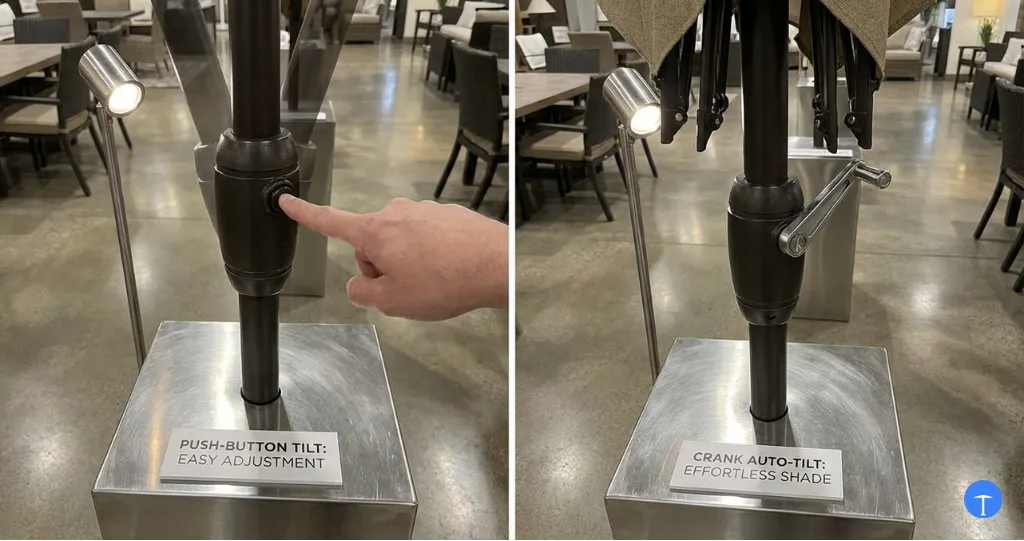
Crank tilt integrates the tilting mechanism directly into the umbrella’s opening system. The same crank handle you use to raise and lower the canopy also controls the tilt angle. Once the umbrella is fully open, you keep turning the crank in the same direction, and the canopy begins to tilt instead of continuing to rise.
This gives you smooth, infinite angle adjustment rather than preset positions. You can dial in the exact shade angle you need by cranking clockwise to tilt or counterclockwise to return to vertical. The mechanism uses a gear system inside the pole that translates the circular cranking motion into angular movement at the top hub where the ribs connect.
The entire operation happens with one hand on the crank. No need to reach up and press buttons or manually push the canopy around. This makes crank tilt particularly useful on larger umbrellas where the canopy weight makes manual pushing more difficult. You’ll find this system on most cantilever umbrellas and market umbrellas 9 feet or larger.
Push-Button Tilt Pros and Cons
Push button tilt shines when you need quick, occasional adjustments and want to keep your umbrella budget reasonable. The mechanism is straightforward and intuitive. Press, push, release. There’s almost no learning curve, which makes it great for rental properties or situations where different people will be operating the umbrella.
The simplicity also means fewer things can break initially. The spring and pin mechanism is robust for the first few seasons. You’re looking at a lower upfront cost compared to crank systems, sometimes $30 to $80 less for similar umbrella sizes and canopy materials.
However, push button systems have notable downsides that appear with regular use. The spring mechanism wears out faster than gear based systems, especially on umbrellas that get tilted daily. After a season or two of frequent use, the button may stick or the spring may lose tension, making the pin harder to engage. The preset positions also limit your flexibility. If the sun is at an awkward angle between two preset tilt positions, you’re stuck with imperfect shade coverage.
The two handed operation becomes annoying when you’re juggling a drink or trying to adjust the umbrella while kids are playing nearby. You need to set everything down, use both hands, then pick your stuff back up. On windy days, holding the button while fighting the canopy angle against the breeze gets old fast.
Crank Tilt Pros and Cons
Crank tilt delivers smoother operation and better longevity, which is why you see it on premium umbrellas and most large outdoor umbrellas. The gear mechanism spreads wear across multiple components rather than stressing a single spring and pin. This translates to more reliable performance over 5 to 7 years of regular use.
The infinite adjustment is genuinely useful. You can match the exact sun angle at any time of day, which means better shade coverage throughout your afternoon barbecue or evening cocktail hour. One handed operation makes adjustments faster and easier, especially when you’re already holding something or the umbrella is positioned where reaching the pole is awkward.
On larger umbrellas, crank tilt becomes essential rather than optional. Trying to manually push a 10 or 11 foot canopy to a tilted position takes real effort, particularly if there’s any breeze. The crank handles that weight for you through mechanical advantage.
The downsides? Higher initial cost, typically adding $50 to $120 to the umbrella price depending on size and brand. The integrated mechanism also means if something breaks, repairs are more complex and expensive. A broken crank system might require replacing the entire pole assembly, whereas a failed push button often just needs a new spring or pin that you can swap yourself.
The mechanism requires occasional lubrication to stay smooth. If you let it go dry, the cranking becomes stiff and the gears can wear unevenly. This maintenance isn’t difficult, but it’s something push button systems don’t need.
Side-by-Side Comparison
| Feature | Push-Button Tilt | Crank Tilt |
|---|---|---|
| Ease of Use | Quick but requires two hands; simple press and push motion | Smoother one-handed operation; infinite angle adjustment |
| Durability | Spring mechanism prone to wear after 2-3 years of daily use | Gear system typically lasts 5-7 years with basic maintenance |
| Typical Lifespan | 2-4 seasons with frequent use; 4-6 seasons with occasional use | 5-7 seasons with regular use; can exceed 10 years with light use |
| Price Range | Budget friendly: $80-$250 for most market umbrellas | Premium pricing: $150-$400+ for similar umbrella sizes |
| Best Umbrella Size | 7-9 foot market umbrellas; manageable canopy weight | 9-13 foot market umbrellas and cantilever styles |
| One-Hand Operation | No, requires both hands to adjust | Yes, complete control with crank handle alone |
Ease of Use
Crank tilt wins for pure ease of operation once you factor in real world use. The one handed adjustment means you can fine tune your shade while holding a coffee mug or keeping a hand on your chair. Push button requires setting things down and using both hands, which gets inconvenient when you’re adjusting the umbrella multiple times during an afternoon outside.
That said, push button is faster for people who only adjust their umbrella once per session. Press, tilt, done. You’re not cranking for 10 to 15 seconds to get the angle right. If you set up your umbrella at the start of summer and barely touch the tilt function until fall, the simplicity of push button makes more sense.
Durability and Longevity
Crank tilt mechanisms outlast push button systems by a significant margin when both get regular use. The gear based design distributes stress across multiple components, while the push button concentrates all the force on a single spring and pin. Commercial patio furniture suppliers consistently report fewer warranty claims on crank tilt umbrellas after year three.
The gap widens with umbrella size. On a 7 foot umbrella, a well made push button system can match crank durability because the canopy weight is manageable. Once you hit 9 feet and larger, the additional strain of manually pushing a heavy canopy accelerates wear on push button components. This is why you rarely see push button tilt on larger market umbrellas or premium models.
Price Range
Push button umbrellas run $50 to $120 less than equivalent crank models, making them attractive for budget conscious buyers or situations where you need multiple umbrellas. A decent 9 foot push button market umbrella with aluminum frame costs $120 to $180, while the same umbrella with crank tilt typically runs $180 to $280.
The price difference narrows slightly at the high end. Premium push button umbrellas with Sunbrella fabric and hardwood frames still cost $250 to $350, while similar crank models go for $300 to $450. You’re paying more for the canopy material and frame quality than the tilt mechanism at that point.
Best Umbrella Sizes for Each
Push button tilt works best on 7 to 9 foot umbrellas where the canopy is light enough to push easily with one hand while holding the button with the other. Beyond 9 feet, the physics work against you. That extra canopy fabric catches more wind and weighs significantly more, making manual tilting a workout.
Crank tilt becomes the practical choice at 9 feet and up. The mechanical advantage of the gear system makes adjusting a 10 or 11 foot canopy effortless. On cantilever umbrellas, which often feature offset canopies of 10 to 13 feet, crank tilt is essentially standard equipment because manual adjustment at that scale is unrealistic for most people.
Choose Push-Button Tilt If…
Push button tilt makes sense when your budget is tight and you plan to adjust the tilt angle occasionally rather than constantly. If you’re furnishing a rental property or vacation home where the umbrella might sit unused for weeks at a time, the simpler mechanism means fewer potential issues when you return.
Go with push button for smaller patios with 7 to 8 foot umbrellas. The canopy is light enough that the two handed operation feels natural rather than cumbersome. You’re also not fighting much wind resistance at that size, so the manual push doesn’t require much force.
This tilt type works well if you have a predictable sun pattern. Maybe your patio gets direct sun from 2pm to 5pm every day at roughly the same angle. Set the umbrella to one of the preset tilt positions that blocks that sun, and you’re done for the season. The inability to fine tune the angle doesn’t matter when the sun follows the same path daily.
Consider push button tilt if you value easy repairs. When the spring eventually wears out, replacement parts cost $8 to $15 and the swap takes 10 minutes with basic tools. Compare that to a broken crank mechanism where you might need to replace the entire pole assembly at $80 to $150.
Choose Crank Tilt If…
Crank tilt is worth the extra cost when you actually use your patio regularly and need to adjust shade angles throughout the day. If you’re hosting weekend barbecues or working outside during afternoons, the ability to dial in perfect shade as the sun moves becomes genuinely valuable rather than a luxury.
Go with crank for any umbrella 9 feet or larger. The mechanism pays for itself in convenience once canopy weight makes manual tilting difficult. You’ll appreciate the one handed operation when you’re carrying plates of food outside or have your other hand on a lawn chair.
Choose crank tilt if multiple people in your household use the umbrella. Elderly family members often find the crank easier than the two handed button system, and kids can operate a crank safely while push buttons might tempt them to play with the spring mechanism.
This system makes sense for exposed locations with variable wind. Being able to quickly adjust the tilt angle to reduce wind resistance on your umbrella helps prevent damage from unexpected gusts. The smooth cranking action lets you make small adjustments without the all or nothing nature of preset button positions.
If you plan to keep the umbrella for 5+ years, factor in the longer mechanism lifespan. The higher upfront cost averages out when the crank outlasts a push button system that needs replacement after three seasons of regular use.
Frequently Asked Questions
Can you convert a push button umbrella to crank tilt?
Converting between tilt types typically requires replacing the entire pole assembly, which costs nearly as much as buying a new umbrella. The mechanisms are fundamentally different in how they’re integrated into the pole structure. If your push button system fails and you want to upgrade to crank, you’re better off buying a new umbrella rather than attempting a conversion. The labor and parts needed for a proper conversion exceed the cost of a mid range new umbrella with the features you want.
Which tilt mechanism breaks first under normal use?
Push button springs and pins wear out faster than crank gears with daily use. The spring typically loses tension after 2 to 3 years of regular tilting, causing the button to stick or fail to lock properly. Crank mechanisms can go 5 to 7 years before needing lubrication or gear replacement. However, if you rarely adjust the tilt, both systems can last the lifetime of the umbrella frame. The difference appears with frequent use.
Are push button umbrellas easier for elderly users or children?
This depends on strength and dexterity. Elderly users often prefer crank tilt because it requires less coordination and physical effort compared to holding a button while pushing a canopy. Children might find push buttons more intuitive initially, but they can struggle with the strength needed to push larger canopies. For accessibility, crank tilt generally wins because it needs only rotational motion at a comfortable height rather than reaching up and applying force in multiple directions.
Which brands make the most reliable push button and crank tilt umbrellas?
For push button reliability, California Umbrella and Tropishade consistently deliver springs that maintain tension beyond the typical 2 year mark. Their entry level models use heavier gauge springs that resist fatigue better than budget brands. On the crank side, Treasure Garden and Galtech manufacture gear systems with brass components rather than plastic, significantly extending mechanism lifespan. These brands cost 20 to 30 percent more than discount options but justify the price through longer functional life. When shopping, check what materials the internal umbrella parts are made from rather than just comparing umbrella fabric and frame.
Can you operate a crank tilt umbrella if the crank mechanism jams?
Most crank systems include a manual override, though it’s not always obvious. If your crank jams, you can often remove the crank handle and use pliers on the square drive shaft to force the tilt adjustment. This isn’t a long term solution because forcing a jammed mechanism can strip gears, but it works in an emergency. Some high end models also feature a release pin that lets you manually adjust the canopy if the crank fails. If your crank consistently jams, the mechanism needs lubrication or the gears may be wearing out. Check the basic tilt troubleshooting for maintenance tips that can prevent jamming.
The Bottom Line
The push button tilt vs crank tilt choice comes down to how often you adjust your umbrella and whether you value lower cost over long term convenience. Push button systems give you functional tilt adjustment at a budget friendly price, perfect for smaller umbrellas and occasional use. Crank tilt delivers smoother operation and better durability, making it the smart choice for larger umbrellas and daily shade adjustments.
If you’re buying a 7 to 8 foot umbrella for a small patio where sun angles rarely change, push button tilt serves you well and saves $50 to $80 on the purchase. If you’re investing in a 9 foot or larger umbrella that will see regular use, the extra cost of crank tilt pays off in convenience and longer mechanism life. Neither option is inherently better, they’re designed for different use cases and budgets.
Consider how you actually use your outdoor space rather than just comparing specs. An umbrella that’s annoying to adjust tends to stay in one position, defeating the purpose of having a tilt function at all. Choose the mechanism that matches your adjustment frequency, umbrella size, and budget reality, and you’ll end up with shade that works the way you need it to.